
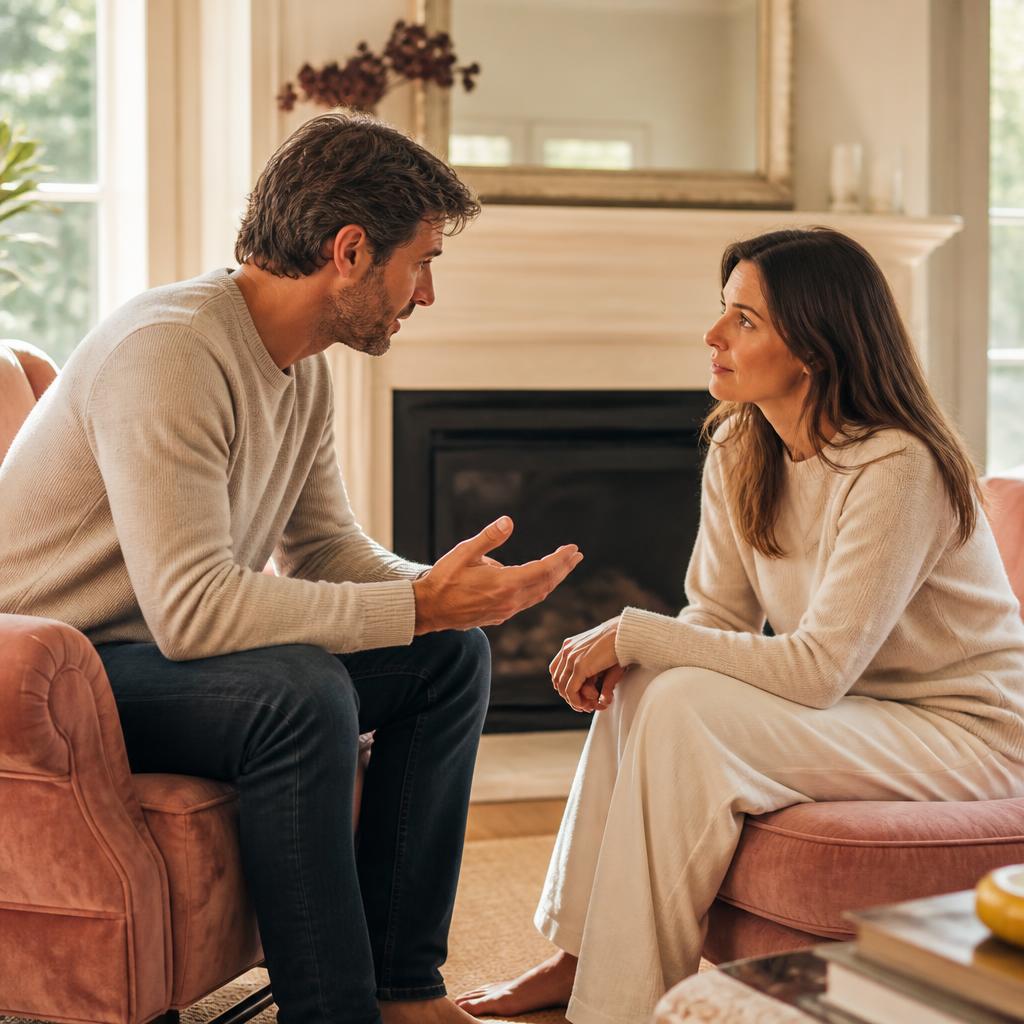
Many couples believe the goal of a good marriage is to avoid arguments completely. It sounds reasonable. If we loved each other more, we would fight less. Right?
Not quite.
Couples who never argue are not always the closest couples. Sometimes they are the loneliest ones, because important feelings and unmet needs quietly stack up until connection erodes. Healthy conflict resolution is not about eliminating disagreement. It is about learning to disagree in a way that protects the relationship instead of chipping away at it.
And it does not begin where most couples think it begins. Resolving conflict does not start with deciding who was right. It starts with understanding what each person experienced, and what the moment meant to them.
When couples understand their conflict patterns and learn better ways to communicate through them, disagreements stop feeling like threats. They start becoming moments of clarity, honesty, and even closeness.
Why conflict happens in marriage
Two people build a life together. They come from different homes, different families, different life experiences, and different nervous systems. Of course they will not agree on everything.
Couples typically disagree because of:
- Different personalities
- Different expectations of marriage
- Different communication styles
- Different family backgrounds
- Different priorities in this season of life
- Different emotional needs
If you and your spouse argue sometimes, that is not evidence something is wrong with your marriage. It is evidence you are two whole people, not two copies of the same person.
It also means that when you disagree, you are rarely disagreeing about one shared event. You are comparing two experiences of the same event, and both of them are real.
The healthiest couples are not the ones who agree the most. They are the ones who know how to move through disagreement with respect.
The difference between healthy and unhealthy conflict
Conflict itself is not the problem. The way you handle it is what determines whether an argument brings you closer or pushes you apart.
Healthy conflict looks like
- Listening. You slow down enough to actually hear your spouse, even when it is hard.
- Respect. You do not weaponize your partner's insecurities, even when you are frustrated.
- Curiosity. You ask what is really going on for them underneath the surface topic.
- Accountability. You own your part instead of building a case against theirs.
- Problem solving. You aim for a solution together, not a verdict on who was right.
- Repair. You come back after the storm and reconnect.
Unhealthy conflict looks like
- Personal attacks. The conversation stops being about the issue and becomes about who your spouse is as a person.
- Blaming. Every sentence begins with "you always" or "you never."
- Contempt. Eye rolls, sarcasm, name calling, mocking. The most damaging pattern in a marriage.
- Avoidance. Sweeping issues under the rug until they turn into resentment.
- Trying to win. Treating your spouse as an opponent instead of a teammate.
- Bringing up old issues. Reaching back three years to prove a point about tonight.
You do not have to be perfect at healthy conflict. You just have to move in that direction, together, more often than not.
The event and what it meant
Many arguments feel repetitive because you are not really fighting about what you think you are fighting about. You are reacting to a pattern, not a topic.
- A disagreement about chores may actually be about feeling unsupported.
- A disagreement about communication may actually be about feeling unimportant.
- A disagreement about time together may actually be about feeling disconnected.
- A disagreement about money may actually be about feeling unsafe.
- A disagreement about the in-laws may actually be about feeling chosen.
There is something else underneath this too. Every conflict has two layers: what happened, and what each person believes what happened meant.
The event is the part you could almost film. The words spoken, the tone used, the door closed a little harder than usual. The meaning is the part you cannot film. "You do not respect me." "You are pulling away from me." "Nothing I do is ever enough."
Many conflicts continue because couples keep arguing about the event when the deeper disagreement is about its meaning. You can go in circles re-deciding the facts of what was said while the actual wound, the meaning it carried, is never addressed.
If you want to understand the pattern beneath the pattern, we go deeper into it in Why couples have the same arguments.
Understand first, resolve second
Most couples skip straight to the part where they work out what should happen next. But you cannot resolve a conflict you have not yet understood.
A sequence that works:
- Establish what each person says happened. Let each of you describe the event in your own words, without correcting each other yet.
- Identify what each person experienced. Not only the facts you would both confirm on camera. What it was like to be you in that moment.
- Identify what each of you believed the event meant. "When you went quiet, I believed you had stopped caring."
- Separate intention from impact where relevant. What you meant to do and what it actually did are two different things, and both are real.
- Make sure each person can describe the other's experience accurately. Not a quick "I hear you." Can you state their experience so well that they would say, yes, that is it?
- Only then discuss what should change. Solutions and agreements come after understanding, not before.
Step five is where most attempts break down. Reflection like "So what I am hearing is that you felt dismissed when I checked my phone during dinner" is the beginning of it. The test is not whether you said something back. The test is whether your spouse heard their own experience, described accurately, in your words.
Understanding is not agreement
Here is the part many couples miss, and it changes everything.
Understanding your spouse is not surrender. It is not admitting fault. It is not accepting the other person's interpretation as fact. It is making sure each person can accurately describe what the other experienced before trying to determine what should happen next.
And here is the other side of it. Two people can reach a point of genuine mutual understanding while still disagreeing.
One of you can say:
"I understand why you experienced that as dismissive. I experienced the conversation differently, and I still don't agree that I was dismissive."
That is understanding without agreement. Both things are true at the same time. You take your spouse's experience seriously, and you do not have to hand over your own.
Some conflicts end in agreement. Many do not, and not every conflict needs to. What a marriage needs in every conflict is not a verdict. It is two people who understand what happened inside each other, and what the moment meant to each of them. Couples who reach that point often find the argument loses most of its heat on its own. And when agreement does come, it tends to hold better, because it is built on understanding rather than exhaustion.
How to resolve conflict in marriage more effectively
The following moves are not complicated. They are simple, and they work when you actually use them.
Choose the right time to talk
Timing matters more than most couples realize. Serious conversations at 11 PM after a long day rarely go well. Neither of you is at your best when you are tired, hungry, or already flooded.
If a hard topic comes up at a bad moment, it is okay to say, "I want to talk about this, and I want to give it a real conversation. Can we sit down tomorrow morning."
That is not avoidance. That is protecting the conversation.
Focus on the issue, not the person
There is a big difference between these two openings:
- "You never care about me."
- "I have been feeling disconnected, and I want us to find a better way."
Same feeling underneath. Only one of them leads to a real conversation.
Attack the problem, not the person. You are on the same team, even when it does not feel like it.
Express needs instead of blame
Blame puts your spouse on trial. Ownership invites them in.
Compare:
- "You never help around here."
- "I feel overwhelmed at the end of the day, and I need us to figure out a rhythm together."
Language like "I feel," "I need," and "I would like" keeps the focus on your experience. That is much harder to argue with and much easier to respond to.
Learning to say the real thing under the frustration is one of the most important skills in a marriage. We cover it more deeply in Marriage communication patterns.
Take responsibility for your part
Almost every conflict has two contributions. It might not be a fifty fifty split, but there is usually something each of you did that made the moment worse.
Accountability is not weakness. It is one of the fastest ways to end an argument.
Saying "You are right, that was not fair of me, I am sorry," takes about six seconds and can defuse an entire evening. Try it before you try anything else.
Repair after conflict
Every couple ruptures. The strong ones repair quickly.
Repair can be simple:
- A genuine apology within the hour, not three days later.
- Acknowledging your spouse's feelings, even if you see the situation differently.
- Showing appreciation for something they did that day.
- A hand on the shoulder, a hug, a soft moment on the couch.
Repair matters more than perfection. What holds a marriage together over decades is not the absence of conflict. It is the presence of consistent, sincere repair.
What to do when emotions become too strong
Sometimes a conversation is heating up faster than either of you can handle. That is a moment where a break is not a cop out. It is wise.
But a break only works if you do it well.
- Communicate that you need time. Do not walk out of the room without a word. Say something like, "I care about this, and I am too flooded to talk clearly. I need thirty minutes and then I want to come back to it."
- Do not use silence as punishment. A break is not the same as the silent treatment. One is a reset. The other is a wound.
- Actually return to the conversation. This is the part most couples skip. Set a time, and come back. Otherwise the issue just gets buried.
- When you come back, focus on resolution, not rehashing. The break was so you could talk better, not just cool off.
A well handled pause can rescue a conversation that would have otherwise turned into a fight both of you regret.
How couples build better conflict habits
The couples who handle conflict well are not naturally gifted. They just have small habits that make hard moments easier.
- Have regular check ins. Fifteen minutes a week, no phones, no kids in the room. Talk about how you are doing, not just what needs to get done.
- Express appreciation daily. One specific thing you noticed. Not "thanks for everything," but "thank you for handling bedtime tonight, I really needed the break."
- Discuss expectations openly. Do not assume your spouse knows what you need. Say it, kindly and clearly.
- Learn each other's communication style. Some people process out loud. Some people go quiet to think. Neither is wrong. Both need to be understood.
- Address issues before resentment grows. The longer a hurt sits unspoken, the heavier it gets.
None of these habits require a therapist, a book, or a weekend retreat. They just require both of you deciding they are worth the effort.
Understanding your conflict patterns
Every couple has predictable ways of responding under stress. If you pay attention, you will start to notice them.
- Pursuing. One partner leans in, wants to talk it out, needs resolution before they can rest.
- Withdrawing. One partner needs space, gets quiet, pulls back when overwhelmed.
- Defending. Every criticism is met with an explanation of why it is not fair or not true.
- Avoiding. The topic keeps getting changed. Nothing hard ever actually gets discussed.
- Criticizing. Feedback comes wrapped in blame. The other partner feels attacked before they know what is happening.
There is nothing broken about any of these patterns. They usually developed in childhood, long before either of you met, as a way of feeling safe. The problem is not the pattern. The problem is when both partners' patterns collide without either of them realizing it.
Awareness gives you a choice. Once you can name what happens between you when things get hard, you can start to do something different. That is the beginning of every real change in a marriage.
You can also feel more of this playing out under the surface in Emotional safety in marriage, which is often the missing ingredient that lets couples finally have the harder conversations.
How the Married By Design Relationship Assessment helps couples improve conflict resolution
Better conflict is not about willpower. It is about awareness.
Understanding both sides of a relationship is difficult when each person only has direct access to their own experience. The Married By Design 9-Dimension Relationship Assessment is designed to show you and your spouse, in plain and honest language, how your relationship actually works. Both partners take it separately, and then you see your results together as a couple.
It helps you understand:
- Your conflict patterns and what triggers them
- Your communication styles and how they collide
- Your level of emotional connection
- The state of trust in your relationship
- Your compatibility across nine core dimensions
- Your relationship strengths worth protecting
- Your blind spots, the ones that quietly cause the same arguments
- Your biggest growth opportunities as a couple
Couples who understand how their relationship works tend to fight less, repair faster, and feel closer, not because they became different people, but because they finally have a shared language for what was already happening between them.
The next argument is coming. That is guaranteed. What is not guaranteed is whether it pulls you apart or brings you closer. That part is up to how prepared you are for it.